Frequently Asked Questions (FAQs)
What kind of training does ESU offer?
We can help you upgrade your writing, reading, math, and computer skills. Because we are an employment-focused program, we also provide opportunities to work on the soft skills necessary for keeping a job: for example, skills that help you work with others and problem-solving.
What is meant by an “employment-focused” program?
Our employment focus means that the work done in class happens in an employment context. For example, we practice reading skills using memos, schedules, and policy forms. We practice writing skills using application forms and notes to co-workers and we practice math skills by using invoices and order forms.
What can I expect when I call?
- We begin by making an appointment to meet with you. We call this the Initial Interview and Assessment.
- At the Initial Interview, we will take some time to listen to your hopes and dreams for your life and how upgrading your skills fits into your hopes and dreams. If what you are looking for is best found at another agency, we will let you know and help you connect with that agency.
- In the Initial Assessment, we take a look at the skills you already have. Then we will set a date for you to start in class. The start date can be as soon as the next day if that fits your schedule.
- Once you start in class, your teacher will help you compare the skills you have with the skills you need to reach your goal. We will help you identify the skill gaps that need to be filled.
- Next, we will prepare a training plan that will help you get the skills you need for your next step – work or retraining. We will provide you with learning materials that will help you build the skills you need and we will help you when you have questions.
- Finally, when you are ready, we will give you a chance to demonstrate that you have learned the skills you needed.
Can I start anytime?
Yes! We are a “continuous intake” program. This means that you don’t have to wait for the beginning of a new semester. You can start at any time, and leave when you have the skills you came for. After your Initial Interview and Assessment, we will arrange a time for you to start. We also offer blended learning with online Employment Ontario upgrading programs including:
In the past, I did not get along very well with math. Should I try again?
Yes! Many learners have come to ESU after years of avoiding math. They came back to relearn math and learn more math because they found out that math skills are helpful for solving all sorts of problems at home, college and work.
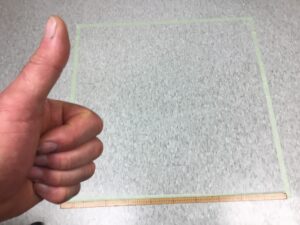
one square meter
At ESU, we think of math as a tool to solve problems .. and we do our best to have fun with math. We try to learn it using things we can see and touch. For example, when we are learning about area and A=LxW, we like to get out tape and make a square meter on the floor – so we can see what a square meter of area looks like.
Based on research, we focus on 4 topics within math that are essential in order for math to be a useful tool: Number Sense, Operation Sense, Mental Math and Problem Solving. Note that long division is not in the list. Unless required for the goal, we do not spend time learning “pencil and paper” calculations when those calculations can be done more quickly and more correctly by calculator or in my head. Curious to know more about our approach to math? Here is a report that explains what we learned when we researched the question, What are the most useful things to learn in math?
Do I have to keep up with the rest of the class?
No. Our learners work in a classroom with other adults who are also working to upgrade their skills. Because each learner is working towards a different goal, each learner is working on their own lessons. That means you don’t have to keep up with anybody else. You can work at your own pace and you can leave when you have the skills you need.
Can I get my diploma at ESU?
No. At ESU, we do not offer high school credits.
But ..
ESU can help you prepare for college even without a diploma! Please see our ESU as a Pathway to College page.
ESU can help you prepare to write the CAEC test (GED replacement) to earn your High School Equivalency Certificate. Please see our CAEC – the GED Replacement page.
And ..
ESU can help you prepare to join the WRDSB’s Re-Engagement program where you can earn credits towards finishing your high school diploma.
If you are interested in upgrading so you can attend St. Louis Adult Learning Centres to earn high school credits towards your diploma, we recommend contacting our friends at St. Louis’ upgrading program: Core Essentials.
What are the Essential Skills?
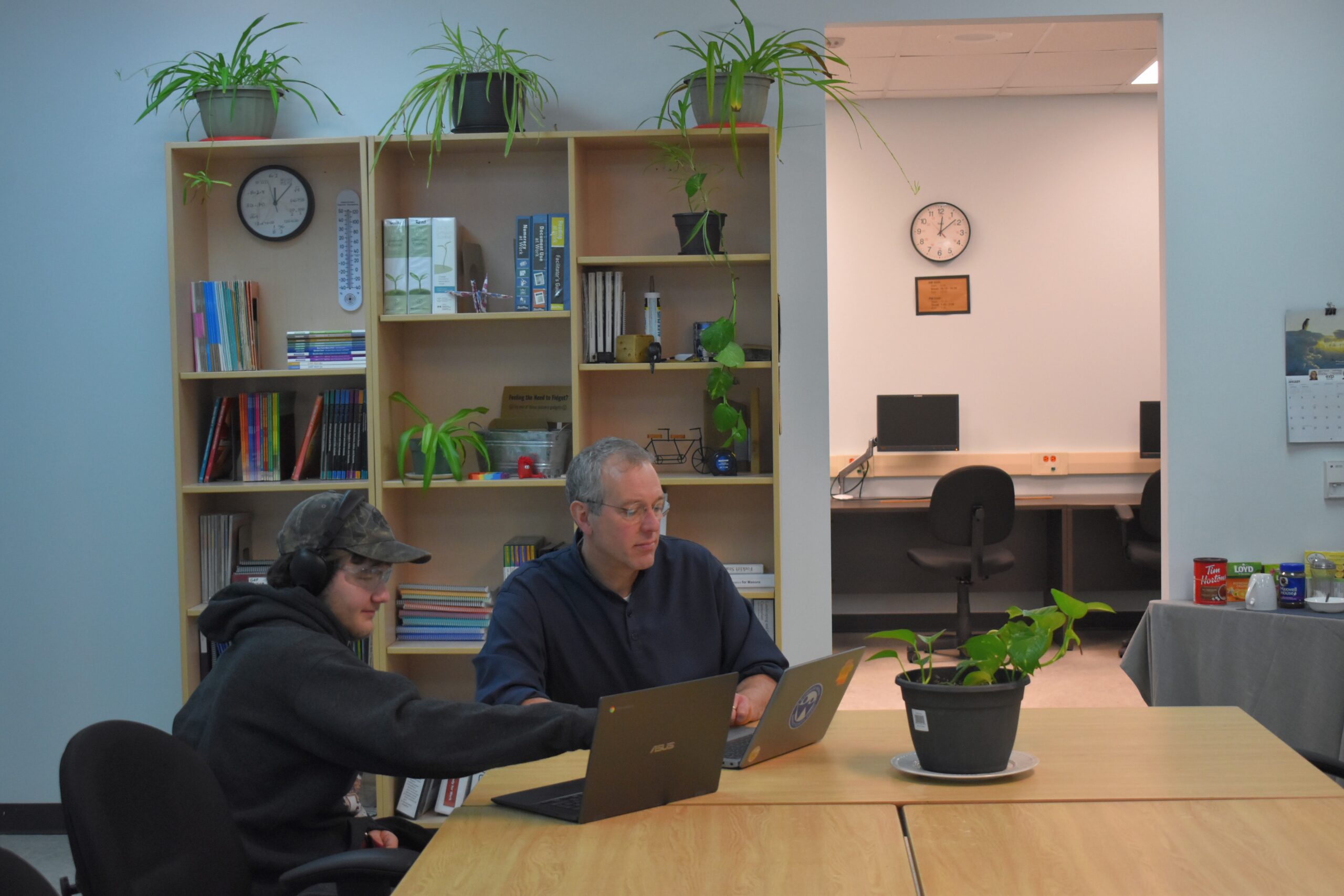
ESU took on the name Essential Skills Upgrading around 2005. From 1996 to 2021, the Government of Canada used the Essential Skills Framework to identify the 9 essential skills for learning, work and life. These nine skills are called “essential” because they are the “velcro” that other skills (such as working with others, and problem solving) stick to. In 2021, the Essential Skills Framework was revised to include more of the “soft skills” necessary for success. The new framework is called Skills for Success Framework. The 9 Skills for Success are:
- Reading.
- Writing.
- Numeracy.
- Digital skills.
- Problem solving.
- Communication.
- Creativity and innovation.
- Collaboration.
To learn more about Skills for Success, visit the Government of Canada’s Skills for Success website.
How many hours of training can I get each week?
Most students at our main sites (ESU-Cambridge and ESU-Kitchener/Waterloo) attend up to 12 hours each week. Typically, this means 3 mornings or 3 afternoons each week. In special situations, students can attend both morning and afternoon classes. Evening classes take place 6 hours per week.
Do I get my own tutor at ESU?
No. However, you will have a teacher who works with you one-on-one in the classroom. The teacher may be helping up to 12 students at the same time. Some of the learning in the classroom happens in groups. Some of the learning happens when learners work away on their own lessons. Because each person is different, teachers move around the classroom spending time with each person. If you are looking for a tutor that works only with you, contact our friends at The Literacy Group.
Do you teach English as a Second Language (ESL)?
We are not an ESL program, however, we do work with people who have English as a second language. If you have English as a second (or third, or fourth…) language, you will benefit most from our program if your speaking and listening skills are around a Canadian Language Benchmark (CLB) level 6 . If you need ESL help, or if you need your English skills assessed, contact the YMCA’s Language Services in Kitchener-Waterloo.